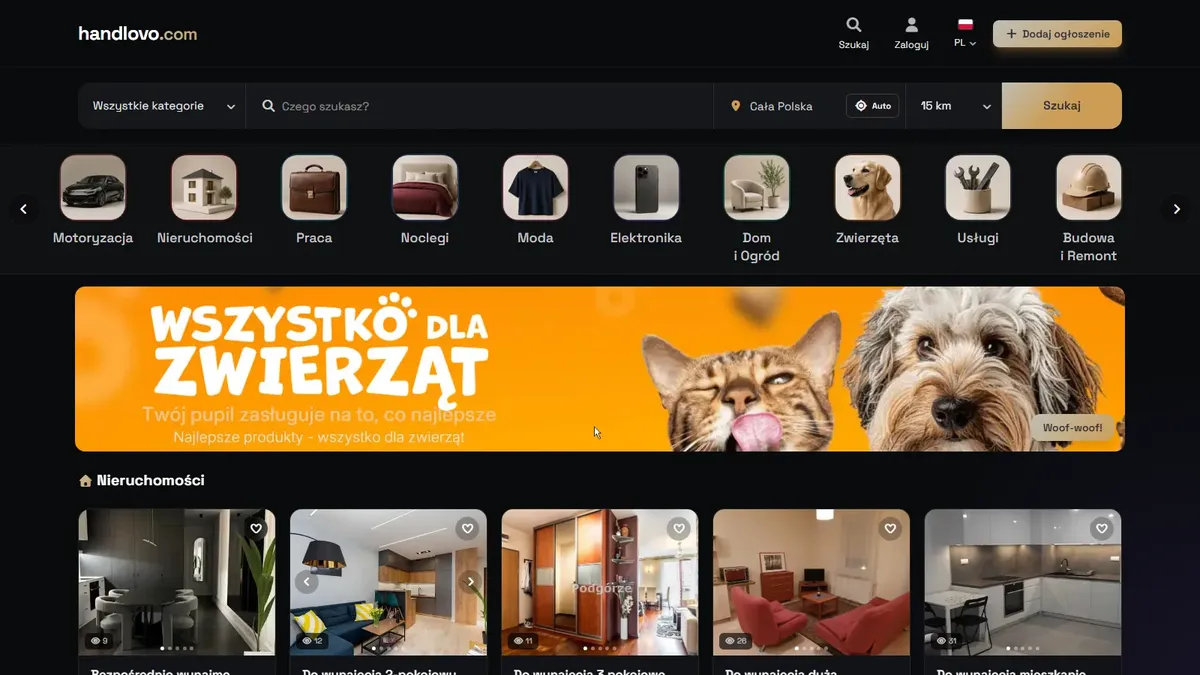
handlovo.com Marketplace
A classifieds platform with Europe-wide reach, designed and built from the ground up — no off-the-shelf classifieds scri…

A site with two entrances — one for companies, one for flat owners — and underneath it an in-house aggregator pulling from eight portals, an email and SMS campaign and a funnel that ends in a signature.
HOST-IN rents accommodation to workers and at the same time looks for property owners to work with. Those are two completely different groups that have to be reached separately — and both are scattered across listing portals rather than sitting in one place you can simply buy an ad on.
Instead of buying clicks, I built an in-house contact acquisition system — the same one described under the apps tab as Listing Monitor, only aimed at rentals.
The figures below are the state of the tool on the day this case was written — not averaged and not rounded up.
In worker accommodation the ad auction is expensive, and it still reaches somebody who happens to be browsing — not the person who has just listed a property. An in-house tool costs once, runs every day and stays in the company together with the contact base. The same layer now serves a second company in the panel, without building everything again from scratch.
A company looking for beds for its crew and a flat owner who wants to let the property look at the same website from opposite ends. The first asks: how many places, from when, is there an invoice, and will somebody sort it out when something breaks. The second asks: who is going to live there, who pays, and what if the flat comes back damaged.
That is why the site has no single shared "contact" button but two entrances placed side by side on the first screen. Each leads down its own path and nobody has to read an offer along the way that does not concern them.
In this trade it is not enough to wait for somebody to find the website. A flat to let appears on a portal and within hours it already has several calls — the one who gets in touch first, and says something concrete, wins.
HOST-IN is interesting here because it shows the whole road in one place: a site that separates two audiences, a tool that delivers the contact, and a funnel that measures what came of it. It is the same layer that now serves a second company in the panel — built once, it works for the next one.
A classifieds platform with Europe-wide reach, designed and built from the ground up — no off-the-shelf classifieds scri…

A venue on the Oder running four businesses at once: a restaurant led by a chef known from television, weddings and corp…

A place where creators from all over Poland list paintings, posters, prints, photography and handmade pieces, and buyers…